"I'm so glad we discovered COOLPHABETS."
Learn Spanish
Your child speaks Spanish at home. School taught them to write in English.
COOLPHABETS teaches children to read and write all 27 Spanish letters by hand, with an on-device AI coach that checks every stroke.
Spoken every day. Written almost never.
In Spanish-speaking families living in English-speaking countries, the children usually speak Spanish well. It is the language of the kitchen, of abuela and abuelo on the phone, and of being told it is time for bed.
Writing it is another matter. School teaches them to read and write in English, and Spanish is left to the ear. The letters look familiar, so everyone assumes it will sort itself out. It rarely does: the accents go missing, the ñ becomes an n, and a note to a grandparent is written in English instead.
Many parents tell us this is what they worry about most. A child who cannot read Spanish cannot read a card from a grandparent, a sign on the next visit, or the stories their parents grew up with. And if one generation stops writing the language, the next has nobody at home to learn it from.
Most language apps
- Teach speaking and listening
- Tap the right answer
- Made for someone starting from zero
COOLPHABETS
- Teaches reading and writing
- Write every letter by hand
- Made for children who already speak it at home
The alphabet
The Spanish alphabet: 27 letters your child will learn
Spanish has 5 vowels, called vocales, and 22 consonants, called consonantes. It shares 26 letters with English and adds one of its own, ñ. The name under each tile is what the letter is called when children recite the alphabet.
Vowels vocales 5
- A a a
- E e e
- I i i
- O o o
- U u u
Consonants consonantes 22
- B b be
- C c ce
- D d de
- F f efe
- G g ge
- H h hache
- J j jota
- K k ka
- L l ele
- M m eme
- N n ene
- Ñ ñ eñe
- P p pe
- Q q cu
- R r erre
- S s ese
- T t te
- V v uve
- W w uve doble
- X x equis
- Y y ye
- Z z zeta
Spanish is written much as it is spoken: once the letters are known, most words can be read aloud straight away. The accent marks are taught with the vowels.
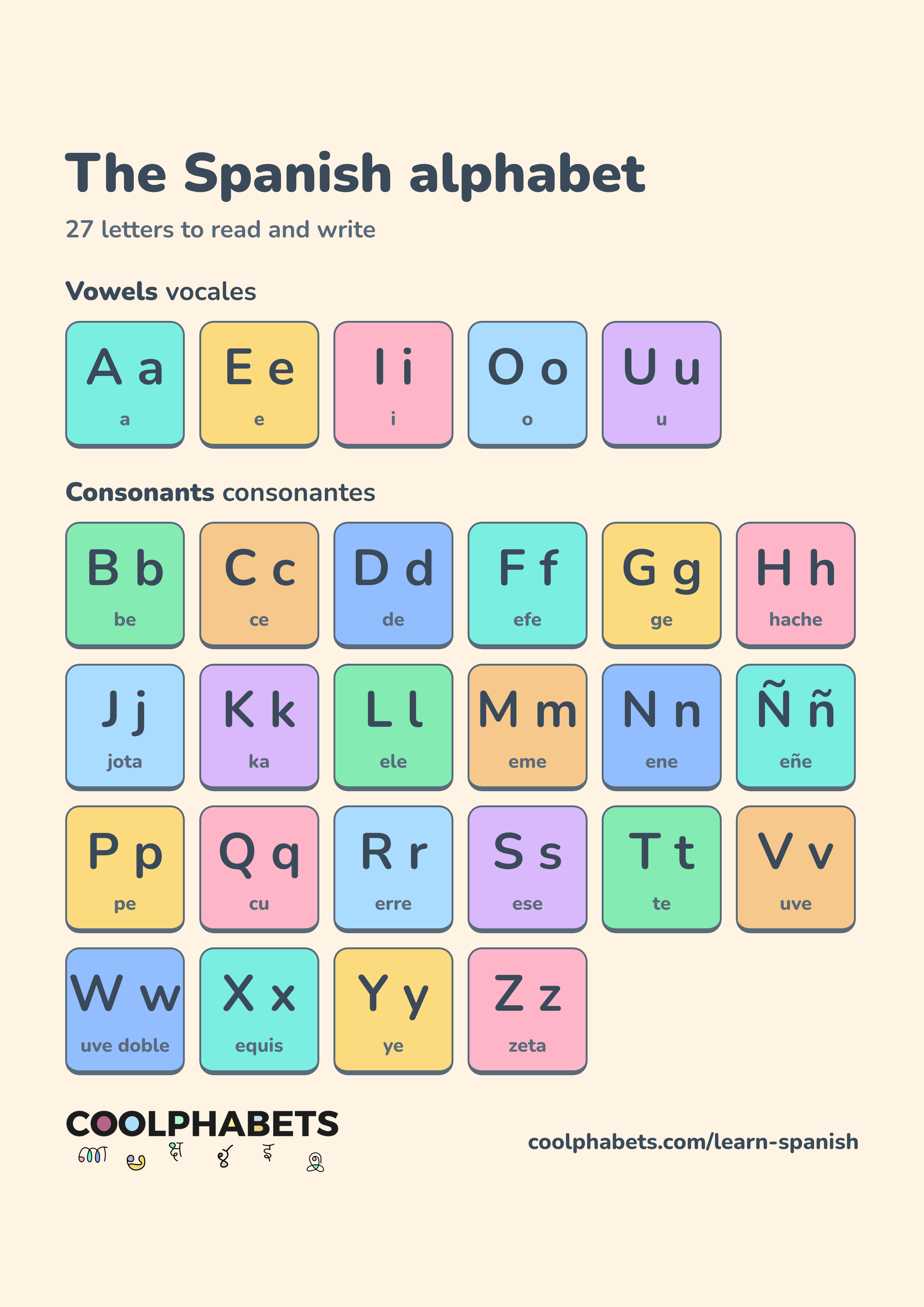 The Spanish alphabet chart All 27 letters on one A4 page. Open it to save, or print it for the fridge door.
The hard parts
What makes Spanish hard to write
A child who reads English already knows the shapes of most Spanish letters. What catches them out is everything English leaves off.
-
The letter English does not have
ñ is a letter in its own right, with its own place in the alphabet, not an n with a decoration. It is in niño (child), mañana (tomorrow) and señor. The wavy mark on top is called a tilde, and leaving it off changes the word.
-
Accents that change the word
A small stroke over a vowel, á é í ó ú, shows which part of the word is stressed. papá is father; papa is a potato. Children who write Spanish by ear leave the accents off, and the AI coach notices.
-
Letters that sound alike, or not at all
b and v sound the same in Spanish, so vaca (cow) is often written with a b. h is silent: hola begins with a letter nobody hears. These are spellings a child has to see, not hear.
-
Marks that open a sentence
Spanish puts an upside-down mark at the start of a question or exclamation as well as the end: ¿Cómo estás? and ¡Hola!. Children used to English forget the one at the front. Words and sentences in the app are where these come into practice.
First words
Five Spanish words to write first
Short words a child says every day, each with one thing to notice when writing it.
- mamá ma-MA mother
The accent on the last a puts the stress there. Without it, the word is read differently.
- papá pa-PA father
The same accent, the same reason.
- casa CA-sa house
Four letters, read exactly as they are written.
- niño NI-nyo child
The ñ in the middle, with its tilde.
- flor flor flower
One syllable, and a rolled r at the end.
How it works
One letter at a time, written by hand.
- 1
Watch. The letter draws itself, stroke by stroke, in the right order.
- 2
Write. Your child writes it with a finger. No tapping on answers, no typing.
- 3
Get checked. CoolphaSense scores the strokes they actually made, on the device.
- 4
Hear it. A native voice says the letter. Or yours, if you record it.
After the letters come words, sentences and games. See everything COOLPHABETS does.
On-device AI
How CoolphaSense checks Spanish handwriting
Spanish uses the same letters as English, so the differences are in the small marks: the tilde on ñ, the accents on vowels, the dots on ü. CoolphaSense has a model trained on Spanish letter shapes, so ñ is judged as the letter it is, not as an n with a stray mark, and a missing accent is noticed.
-
Instant feedback
The check runs on the phone or tablet itself, so your child sees the result as soon as the letter is finished.
-
Checked on your device
Handwriting is checked right on your phone or tablet. There is no call to a central AI model.
-
Works offline
On a flight or a long drive, the coach keeps working without internet.
-
Tiny and patented
Each language has its own small model, built into the app. CoolphaSense is covered by multiple patents.
Questions
What Spanish parents ask us
My child already reads English. Is Spanish not the same alphabet?
Almost. Spanish shares 26 letters with English and adds ñ. The shapes are familiar, but the sounds, the accents and the spelling rules are not, and that is what COOLPHABETS teaches. A child who reads English has a head start, not a finished job.
My child speaks Spanish but has never written it. Where do we start?
With the five vowels and their accents, then the consonants, one letter at a time, before moving on to words and sentences. A child who already speaks Spanish knows the sounds and only has to connect them to the letters.
Our family is from Mexico, Colombia, Spain or elsewhere. Does it matter?
Not for the alphabet. The 27 letters, the accents and ñ are the same wherever Spanish is written. Spoken Spanish varies from place to place, but the letters do not.
I speak Spanish but never learned to write it properly. Can I use it too?
Yes. One plan covers 4 family members, and plenty of parents work through the accents and spelling rules alongside their children.
Can my child hear the letters in my voice?
Yes. Every letter, word and sentence comes with a native Spanish voice, and you can record your own over it, so your child hears Mamá or Papá saying the letter.
What does it cost?
One family plan at $99 a year, with a 7-day trial that needs no payment. Once installed, it works offline, including the handwriting check.